
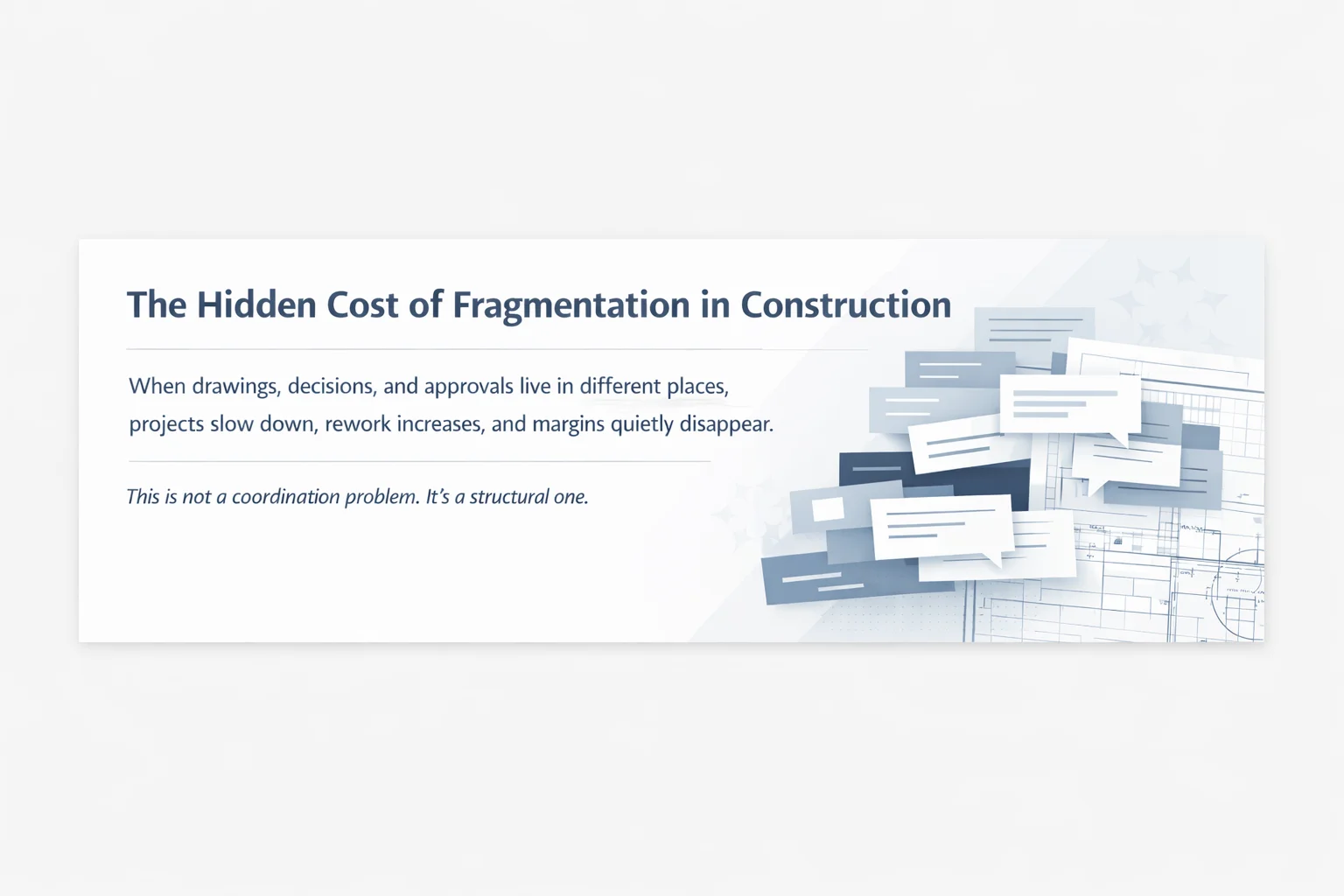
“Which drawing are we supposed to follow?”
The site engineer has one version saved on WhatsApp.
The consultant refers to a revised drawing sent over email last week.
The contractor insists an approval was “given verbally” during a site visit.
The project manager scrolls through message threads, screenshots, and PDFs – trying to piece together what was actually decided.
Decisions stall and work slows.
This is a familiar reality across construction projects of every scale.
Every delay feels small until it costs 10 days and ₹40 lakh in rework. What appears on site as a minor coordination issue quickly escalates into something far more damaging.
Even when the construction industry operates at high risk, stringent deadlines, and massive complexity, a fundamental challenge persists – fragmented communication and unstructured documentation.
This isn’t just inefficient. It’s expensive. Industry data reveals that construction inefficiencies cost the global industry over $1.6 trillion every year.
When dozens of stakeholders are involved, fragmentation is no longer a minor inconvenience: it becomes the single largest contributor to delays, rework and disputes.
The Scale of the Problem
Construction professionals today spend up to 30–35% of their working time simply searching for information, reconciling versions, or resolving misunderstandings caused by poor coordination.
Miscommunication and unstructured data alone are responsible for:
- One-third of project failures, where failure is defined as exceeding planned cost or timeline
- More than 50% of rework incidents, directly linked to outdated drawings, unclear instructions, or missing approvals
- Tens of billions of dollars in annual rework costs across major construction markets
In other words, fragmentation isn’t just human error, it’s a systemic issue.
Where Construction Teams Bleed Time & Money ?
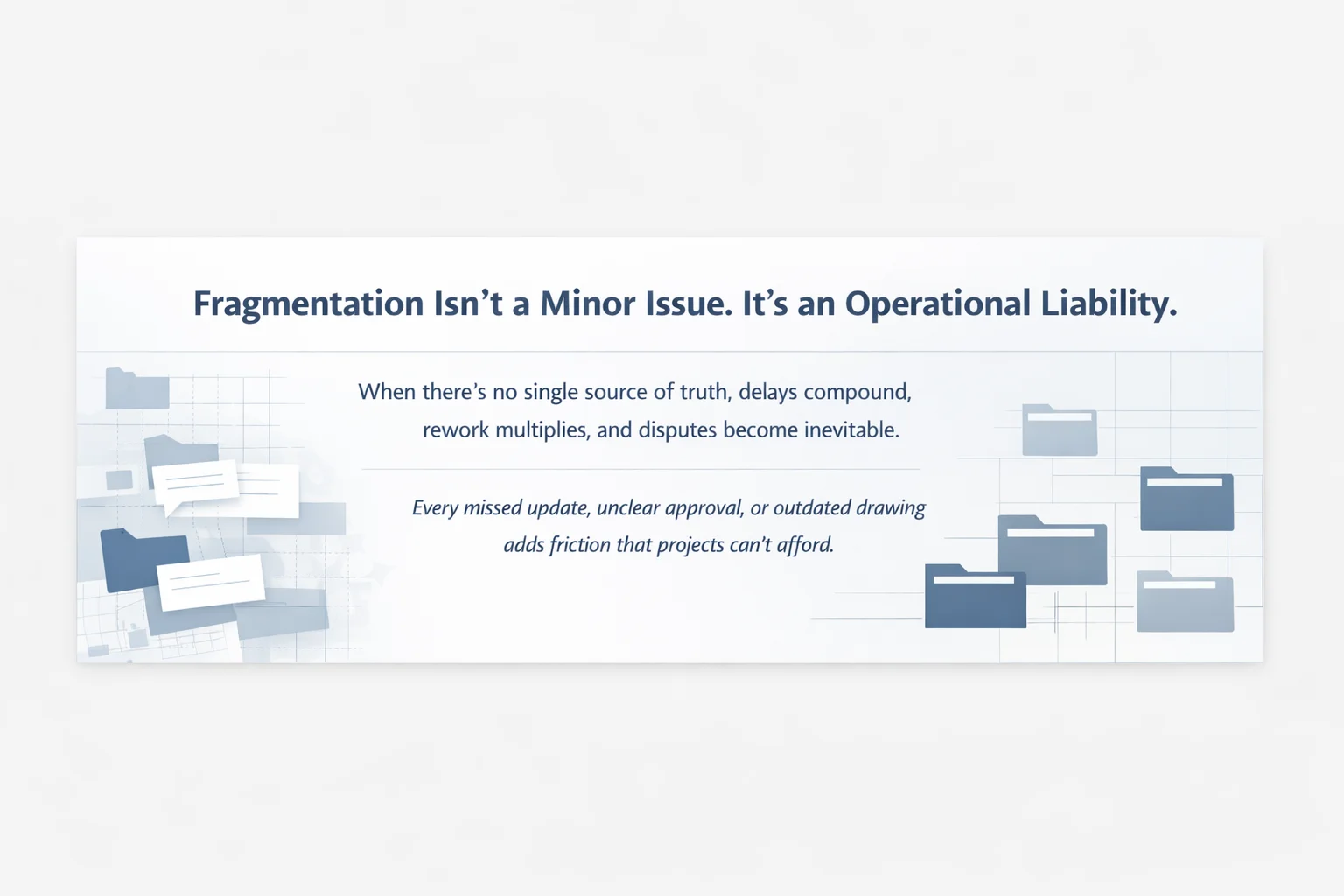
Profitability and project quality are systematically eroded by the absence of a unified digital workspace. Efficiency is compromised in the following key areas:
| ISSUES | PROBLEM AREA | IMPACT ON COST & TIME |
|---|---|---|
| Fragmented Communication | Decisions scattered across WhatsApp, emails, and calls | Missed instructions, delayed decisions, repeated clarifications |
| Dispersed Project Information | Drawings, BOQs, contracts, and approvals stored across devices and threads | Time lost searching for data; site progress stalls |
| Lack of a Single Source of Truth | No version control or approval traceability | Rework, material wastage, billing conflicts |
| Manual & Slow Approvals | Offline sign-offs and untracked message chains | Bottlenecks that push critical activities off schedule |
| Unstructured Site Reporting | Context-free photos and ad-hoc updates | Poor visibility; issues surface only after escalation |
| Weak Accountability & Audit Trails | No clear ownership of decisions or delays | Disputes, claims, and erosion of project margins |
Each of these issues compounds the other—creating a cycle where delays fuel rework, rework fuels disputes, and disputes destroy margins.
The Path to Operational Excellence
What if these inefficiencies are not accepted as a “part of construction” and are seen for what they really are – operational liabilities.
Breaking this cycle requires a shift from fragmented communication to unified collaboration of a single, structured environment where:
- Information is centralized
- Decisions are traceable
- Approvals are auditable
- Progress is visible in real time
But is it really possible?
Action: Introducing Collabworx
Yes! Structured collaboration is already reshaping how Indian projects operate. We stopped accepting chaos as the industry standard and did something about it.
Imagine if you didn’t have to dig through WhatsApp for that final file, and instead had a single dashboard where final_1_final_done.dwg was clearly tagged, approved, and accessible in seconds.
Collabworx is India’s first purpose-built, multi-stakeholder construction collaboration platform—designed specifically to eliminate the fragmentation that bleeds time, money, and trust from projects.
By unifying communication, documentation, approvals, and site updates into a single digital workspace, Collabworx closes the gap between project management and ground reality—turning scattered information into structured, actionable intelligence.
Because in an industry where margins are thin and timelines unforgiving, coordination is not a soft skill—it’s a strategic advantage.
Ready to transform your project management from a liability into a high-efficiency asset?
 TALK TO US ?