

If you’ve worked on a construction project in India, you already know how information moves in real life. A drawing goes on WhatsApp, an approval gets buried in an email thread, a clarification sits in someone’s call notes, and a vendor prints the revision he received first because he didn’t see the update. Nothing is technically wrong; everyone is doing their best, but the process still slips.
And that’s the problem.
Construction doesn’t fail because people don’t talk.
It fails because they talk everywhere.
WhatsApp and email are brilliant for quick chats and sharing attachments, but when 50–200 stakeholders are working together across months or years, they simply can’t handle the complexity. That’s when mistakes begin to cost real money, real time, and real trust. With at least 4–6 different stakeholders involved in most construction projects, this kind of scattered communication directly impacts construction data security, not just collaboration.
So, when teams say they want to “improve collaboration,” what they’re really trying to fix is scattered communication. And to do that, there must be a better way than juggling six different channels daily.
Let’s talk about it.
Why WhatsApp & Email Break Down in Construction ?

WhatsApp is fast, and email feels official, but they weren’t made for multi-team coordination on live construction projects. Once a project scales, they start showing cracks.
Here’s what usually happens:
- Updates get lost inside huge message threads
- Attachments disappear under unrelated images and forwards
- Approvals sit unread in inboxes
- No one knows which drawing is final
- Clarifications get repeated because no one remembers where they were discussed
- Accountability becomes guesswork
- Teams waste hours searching instead of building
Still managing drawings and approvals across WhatsApp and email? See how Collabworx helps construction teams work from one structured workspace.
And what starts as small confusion quietly grows into rework, delays, extra material, and unhappy clients.
Because if five versions of the same drawing exist…
somebody will end up using the wrong one.
And when that happens, everyone pays for the mistake.
This breakdown is one of the most common collaborations challenges we see across Indian construction projects.
Why Existing Construction Tools Still Fall Short
Many tools in the industry were built either for design teams or for ERP-driven project tracking, but most real construction work happens in the messy middle; between drawings, discussions, decisions, and documents.
Some platforms focus only on file sharing and storage, while others are heavy, rigid systems meant for financial and billing workflows. But neither handles the day-to-day information flow between multiple stakeholders working across different companies.
And that’s why chaos continues: there’s no shared space to keep communication, versions, approvals, and accountability connected in real time.
Why Not Just Use Google Drive or Slack?
Tools like Drive or Slack are great for office teams, but they break when 50+ people need drawings, revisions, and documentation every day. Drive doesn’t enforce version sequence or traceability, and Slack doesn’t structure files by project stages. None of them handle multi-company permissions either. Construction needs structure more than storage and that’s what collaboration platforms are built for.
Real Scenarios You’ve Probably Seen Before
- The site engineer prints a drawing shared on WhatsApp last week because he didn’t notice the updated version buried under 200 messages
- A vendor fabricates the wrong component because the email with changes reached the junk folder
- Two contractors work on two different revisions because nobody knows which file is actually final
- A client asks for proof of approvals, but tracking them means digging through endless email chains
- A dispute over a change order turns into a blame game because there’s no record of who approved it
None of these happen because teams are careless.
They happen because communication isn’t structured.
The Real Cost of Scattered Communication
A single version mistake can cost crores over the lifecycle of a project when you consider labour, material, idle time, redesign effort, and extended timelines. Even losing just 30 minutes a day to searching for files equal hours of productivity loss per team member every year. When you multiply that across contractors, consultants, site staff, and vendors, the cost of chaos quickly outweighs the cost of organised collaboration.
In India, where RERA expects traceable documentation and approvals, these gaps often surface during audits or disputes.
Why Construction Needs Something Better ?
Construction isn’t like office work. A single project often involves 4–6 core stakeholders and several subcontractors working in parallel, across site and office.
Collaboration tools solve this by giving everyone a single place to work from where every drawing, approval, and update stay connected and traceable.
They turn scattered communication into one clear source of truth.
What Collaboration Tools Do Differently ?
Instead of jumping between chats, emails, folders, and calls, collaboration tools:
- Keep all updates inside one project workspace
- Attach conversations directly to drawings or files
- Maintain one final version automatically with older files locked
- Provide role-based access so vendors and consultants only see what they need, a key requirement for construction data security in India.
- Build audit trails for who changed what and when
- Store documentation in structured, sequenced folders
- Reduce rework by ensuring everyone sees the same reference at the same time
It’s not technology replacing people, it’s structure replacing chaos.
The real value isn’t in adding another app. It’s in creating a structured information layer that works independently of ERP systems and replaces scattered communication with audit-ready traceability. It bridges the gap between communication and documentation so that even when teams change, projects don’t lose their memory. We’ve explored this structure-first approach in more detail in our guide to construction collaboration tools and real-world use cases.
What Actually Changes When You Move Beyond WhatsApp & Email ?
Fewer Communication Gaps
Every update sits right next to the drawing or report it belongs to, so nobody has to dig through old messages.
Faster Approvals
Pending actions are visible in one place instead of hiding inside inboxes.
Clear Accountability
You always know who uploaded, approved, or revised something: no confusion, no arguments.
Reduced Rework
When the whole team uses the same version, mistakes disappear before they start. Even one outdated drawing can set work back by days or weeks when multiple contractors depend on it.
Stronger Compliance
Audits, RERA documentation, legal reviews, and handovers become easier because everything is organized and timestamped.
Calmer Teams
People stop firefighting and start actually working.
This directly supports RERA compliance, where organized, time-stamped records are critical.
A Quick Real Example
On a mid-size residential project in Pune, the MEP contractor worked off an old drawing shared weeks earlier on WhatsApp, which led to rework worth ₹4.8 lakhs and a two-week delay. Once the team switched to a structured workspace where the latest files were clearly marked and older versions were locked, the same issue never repeated. What changed wasn’t effort, it was clarity.
Before vs After Snapshot
| Before | After |
|---|---|
| Multiple drawing versions in WhatsApp | One final, traceable version |
| Approvals lost in email chains | Clear visibility of pending actions |
| Repeated clarifications across groups | Discussions stored with the correct file |
| Rework caused by outdated references | Real-time updates on one system |
| No documentation discipline | Structured folders with full history |
Why Teams Resist Change (And How to Overcome It)
Many construction teams don’t stick to new systems because the shift feels uncomfortable at first. People know WhatsApp and email well, and anything new seems like extra work. The truth is that resistance isn’t about technology at all, it’s about habit and fear of disruption.
The most effective way to bring teams onboard is to start small, show early wins, and make the new process feel lighter than the old one. When people see fewer mistakes, faster decisions, and less back-and-forth, adoption becomes natural not forced.
How to Transition Smoothly (Without Overwhelming Your Team) ?
- Start with one pilot project
- Set one standard folder structure
- Train site engineers first
- Reduce parallel channels gradually
- Review feedback after a few weeks
Small changes stick longer than dramatic announcements.
How to Switch Without Disrupting Ongoing Projects ?
The smoothest transitions don’t replace everything overnight. Start with one pilot site, set one naming standard for files, onboard core team members, and gradually reduce dependency on parallel channels. Once people feel the ease, scaling becomes automatic.
A Project Continuity Platform, Not Just a Communication App
Most tools help teams communicate, but Collabworx focuses on something deeper: continuity. The platform keeps every project’s history, documentation, decisions, and file sequence intact, regardless of how many contractors, consultants, or companies are involved.
This makes it possible to maintain clarity and control across months and years, and across teams and locations without depending on individual inboxes or WhatsApp groups.
In an industry where staff movement, contractor turnover, and compliance pressure are constant, continuity is not an advantage; it’s survival.
The Bottom Line
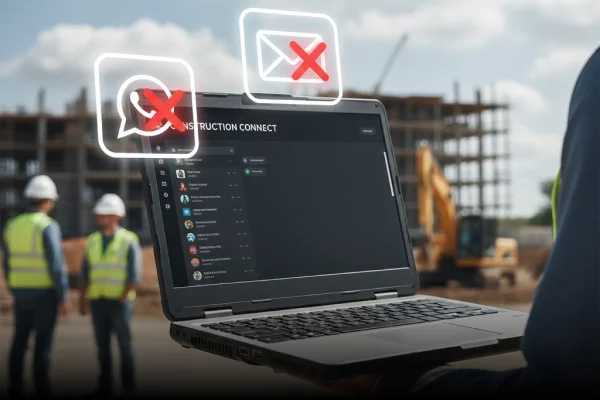
WhatsApp and email will always have a place but not as the backbone of construction projects.
Projects run smoother when teams stop searching for information and start working from the same page, literally and figuratively.
Collaboration is not about adding more tools; it’s about removing confusion.
When information flows clearly, everything else follows: trust, speed, quality, and confidence.
Ready to See the Difference?
Do you want to experience better construction data security? If your projects still rely on WhatsApp, email, or open Drive links, it’s time to see how role-based access can protect drawings, approvals, and documentation without slowing teams down. Start a free trial to experience secure, structured collaboration or Book a demo to see how Collabworx improves data security and RERA-ready documentation across real projects.
 TALK TO US ?